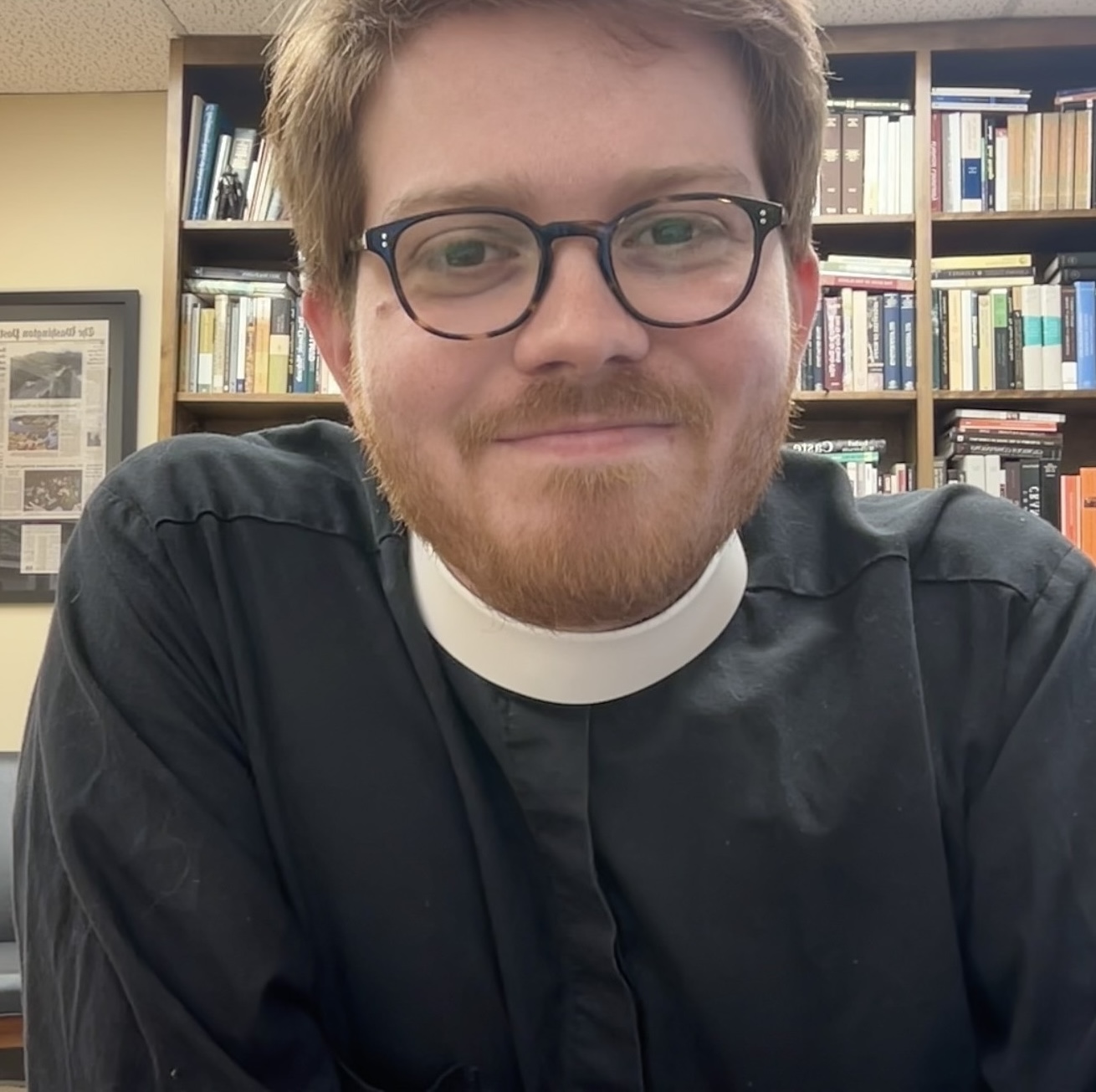
Preached on Sunday, August 30, 2026, the Fourteenth Sunday after Pentecost, at Trinity Episcopal Cathedral in Little Rock.
“God said to Moses, ‘This is my name forever, and this my title for all generations.’” (Exodus 3:15)
This morning, I’d like to tell you about just one of those generations.
I was about five years old the first time I heard that story from Exodus. It remains the earliest Bible story I can remember. It was Vacation Bible School at my grandparents’ church, First Baptist over on Pleasant Valley. One morning our class was led into a dimly lit room where cardboard rocks and brown butcher paper had been arranged to resemble a wilderness. Sitting beside a homemade burning bush was an older man named John Corbett. I have forgotten almost everything else about that week, but I have never forgotten John Corbett.
As we entered the room, he switched on the bush—yes, the bush had a switch! It glowed bright orange in the darkness. Then, in a booming voice, he called out, “Come no closer! Take off your shoes. You are standing on holy ground.” Five-year-olds are wonderfully literal. Off came our shoes and socks, and we sat barefoot around that little lightbulb bush.
Then he asked us a question. “Do you know My Name?” A few children answered, “God! You’re God!” Mr. Corbett smiled and said, “Yes—but what is My Name?” The room fell silent. None of us knew. Then he leaned toward us and said, “I AM WHO I AM.”
I remember thinking it was some sort of trick. What kind of name is that? It turns out Moses had the same question. When God sends Moses back to Egypt, Moses asks the obvious question. “If the Israelites ask me, ‘What is His Name?’ what shall I say?” In the ancient world, a name means everything. A name told you something about a god’s character, reputation, even the work that god was supposed to do. There were gods of rain and gods of war, gods of fertility and gods of the harvest. A god had a portfolio, a responsibility, a job description. And so, Moses wants to know: Who is this God? What does He do? What can Israel expect from Him?
God’s answer is unlike any other in the ancient world or in Holy Scripture: “I AM WHO I AM,” or perhaps, “I WILL BE WHO I WILL BE.” The Hebrew is difficult to capture in English, and perhaps that is precisely the point. God’s Name refuses to fit neatly inside a definition. This is not the god of this or the god of that. This God will not be assigned a portfolio. He cannot be reduced to a particular function or be confined to our expectations. He will not be managed or mastered or controlled. He is Who He is. He will be Who He will be.
And that is exactly what Israel is about to discover. Before God ever reveals His Name, He reveals His heart. “I have observed the misery of my people. I have heard their cry. I know their sufferings. I have come down to deliver them.” This God hears and sees and knows and acts. He brings plagues upon Egypt and divides the sea. He leads through the wilderness and feeds His people there. He gives commandments and forgives rebellion. He does not simply have one thing that He does. He is the living God. That is Who this God is.
And Israel will spend the next forty years continuing to discover what that Name means. They will learn it at the Red Sea and in the wilderness. They will learn it when manna appears with the morning dew and when water gushes from the rock. They will learn it in moments of profound faithfulness and in moments of astonishing failure. They will never exhaust the meaning of the Name because they will never exhaust the God who bears it. And neither will we.
Whenever you read your Bible and encounter the word LORD printed in all capital letters––such as in this reading from Exodus or in today’s Psalm––you are seeing a reminder of this Name. Behind that little word are the four Hebrew letters of the Divine Name revealed here at the burning bush. Out of reverence, Jewish tradition came not to pronounce the Name itself but to say instead Adonai—“the LORD”—and we Christians have inherited that practice. All this to say: that little word is meant to take us somewhere. Every time we encounter the word “LORD” in the Scriptures, we should go back to the bush. We should remember the God who simply says, “I AM”––the God Who cannot be contained by our definitions, limited by our expectations, or controlled by our desires; the God Who sees, Who hears, Who knows, and Who comes down to deliver.
That is why this story never becomes old. Most of us have known this story for years. Some of us have heard it since we were children. We know about the bush. We know about the sandals. We know the words, “I AM WHO I AM.” But knowing the story is not the same thing as knowing the God Who speaks from the fire.
The Christian life, in many ways, is a lifelong return to the burning bush. Again and again we discover that God is greater than we imagined. We think we know what He is about to do, and then He surprises us. We think His mercy has reached its limit, and it hasn’t. We think our failures have the final word, and they don’t. We think we know exactly what God ought to do, how God ought to act, whom God ought to bless, and where God ought to be found. And again and again, the living God refuses the little boundaries we draw around Him.
That can be unsettling. We would often prefer a god with a job description, a god whose behavior we could predict, a god who could be summoned when needed and safely put away when not. But such a god would only be an idol. The God of Abraham, Isaac, and Jacob is beyond our control. We do not possess Him. We do not manage Him. We do not finally comprehend Him. We can only receive Him as He gives Himself to us: “I AM WHO I AM.”
And strangely enough, that is good news. The mystery of God’s Name is not meant to frustrate us. It is meant to free us from imagining that God can ever be reduced to our expectations. The God Who met Moses in the wilderness is always more faithful than we expect, more merciful than we deserve, and more alive than we remember.
Perhaps that is why Moses was told to remove his sandals––as well as those little 5 year olds over at the First Baptist Church. Holy ground is the place where our certainty gives way to wonder. And that is where every Christian life begins, and where every Christian life returns. We come before the living God again and again, not because we have finally figured Him out, but because there is always more of Him to know. We stand barefoot before the One whose Name endures forever, whose mercy never fails, and whose work in our lives is never finished.
“This is my Name forever, and this my title for all generations.” Amen.


Leave a Reply