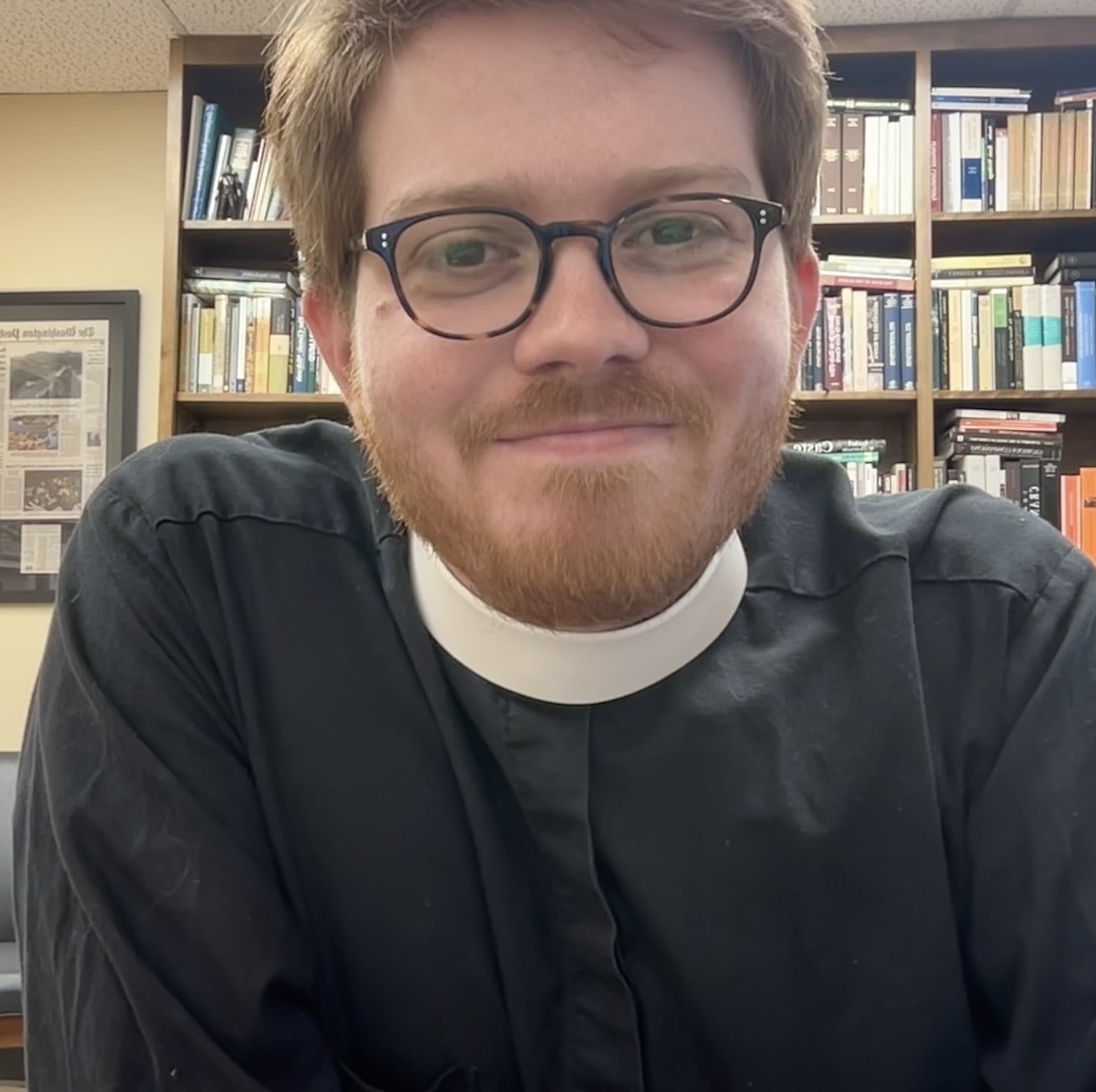
Preached on Sunday, November 15, 2026, the Twenty-Fifth Sunday after Pentecost, at Trinity Episcopal Cathedral in Little Rock.
The slave said to the master, “I was afraid, and I went and hid your talent in the ground.” (Matthew 25:25a)
This morning, I’d like to talk with you about fear. Fear is one of the most common experiences of human life, and there are all sorts of good reasons for us to be afraid. We become afraid when we encounter something we cannot understand, when we face something we cannot control, or when we begin to suspect that the future might not turn out as we had hoped.
But I specifically want to talk with you about what happens to us when we carry fear, when we begin to live our lives afraid. For you see, fear is one of those things that changes our character. We walk through the world a bit differently when we carry fear. We become more concerned with what might go wrong than with what might go right, and we become increasingly convinced that there is very little we can do about any of it.
As such, I think that if we are afraid long enough, fear begins to change something about the way we understand the world. We become suspicious of other people, disillusioned with the circumstances around us, and increasingly doubtful that anything good can come of our efforts. Sometimes our fear becomes bitterness, and sometimes it becomes cynicism, which has the peculiar advantage of allowing us to feel rather wise about our own fear. We convince ourselves that we are simply being smart or realistic, when, in fact, we may have become so afraid that we have lost the courage to imagine anything else.
And when all of that happens, we begin to withdraw. We withdraw from the world around us, but we also withdraw from our own responsibilities within the world. We become reluctant to take chances, unwilling to expose ourselves to failure, and increasingly content to leave the problems of the world to somebody else. What began as fear has gradually become something more serious, because it has persuaded us that the safest thing to do is nothing.
And that is the issue. Fear leads us toward despair, toward an inability to act, toward a kind of frozenness. Despair is not simply the recognition that things are bad, but the conviction that they cannot be otherwise. It is the belief that the future has already been decided, that our efforts will amount to nothing, and that there is very little reason to try. Eventually, we become so accustomed to the world as it is that we can scarcely imagine the world as it might be. We have allowed our fear to determine the limits of our imagination.
If you struggle to visualize what I am describing, come with me to this morning’s Gospel passage.
Jesus tells us about a man who entrusts an extraordinary amount of money to three of his slaves before leaving on a journey. Even the third slave receives a talent, an amount equivalent to roughly twenty years of an ordinary laborer’s wages. Two of the slaves put their money to work, and both manage to double what they’ve received. But the third slave takes his portion, digs a hole in the ground, and buries it. When the master finally returns, the slave explains his decision: “I was afraid, and I went and hid your talent in the ground” (Matthew 25:25a).
Now, what’s so interesting about this slave is that he’s done nothing particularly unreasonable. In the ancient world, burying money was a recognized way of keeping it safe. And this man was a slave entrusted with an enormous fortune by a master whom he believed to be harsh and demanding (Matthew 25:24). He had good reason to worry about what might happen if something went wrong. So, he did what seemed to be the safest thing imaginable. He buried the money in the ground, where nothing could happen to it.
And that’s precisely the problem: nothing happened to it.
Notice how thoroughly his fear has shaped his understanding of the situation. He can imagine all the terrible consequences of losing what he has received, but he seems incapable of imagining what might happen if he puts it to good use. His fear has become the governing principle of his life, persuading him that the safest course is to do nothing at all. What he regards as prudence, his master regards as a profound failure of faithfulness.
I wonder how often something similar happens to us. We look around the world and see war, hunger, poverty, and suffering on an unimaginable scale, and we wonder what difference we could possibly make. We look at our own country and see division, anger, and distrust, and we become discouraged by the apparent impossibility of changing anything. We look closer to home, here in Arkansas and in Little Rock, and see children growing up without the opportunities they deserve, families struggling to make ends meet, and communities confronting problems that have persisted for generations. And everywhere we look, the needs seem so enormous, the obstacles so great, and our own ability to do anything about them so terribly small.
But this happens in the quieter circumstances of our lives, too. We hesitate to reach out to a struggling neighbor, to confront something we know is wrong, to become involved in the life of our community, or even to repair a relationship that has become strained. We are afraid of getting involved, of being disappointed, of making a mistake, or of discovering that our efforts will accomplish nothing at all. And so, at every level of our lives, from the great troubles of the world to the ordinary circumstances of our own homes, fear persuades us that there is little reason to try. It’s not that we don’t care, but that we have become so afraid that what we have to offer will be so insufficient that we never offer it at all.
Of course, there are limits to what we can accomplish. But there is an enormous difference between recognizing that we cannot do everything and becoming convinced that we cannot do anything. We Christians can oh so easily begin to live as though there’s nothing particularly hopeful about being alive in the world God has made. And when that happens, we have given our fear an authority it doesn’t deserve.
And the tragedy of all this is that God has entrusted every one of us with something. God has given us our lives, our time, our abilities, our resources, our relationships, and all those gifts and opportunities that make each of our lives particular. We have not all been given the same things, but every one of us has been given something, and what God has given us is not meant simply to be preserved, protected, or kept safely for ourselves. It is meant to be used, to be put to work for the sake of our neighbors, for the good of the world, and for the purposes of God. When we become so afraid that we refuse to use what we have been given, we risk burying the very things through which God might have done something good.
One of the things I learned from my preaching professor in seminary is that every sermon ought to lead us somewhere. It ought to lead us toward some action, some contribution, some next step in the life of faith. And I suppose that means I ought to tell you this morning to go out into the world and do something courageous, to take some great risk for the sake of what’s good.
But I wonder whether the first step for us this morning might be something rather different. Perhaps it’s simply to recognize how much of our lives are governed by fear, how much of the world around us operates out of self-preservation, and how easily that fear becomes despair. Perhaps we ought to ask ourselves how often we have mistaken our fear for wisdom, our despair for realism, and our unwillingness to act for a sensible understanding of how things really are. And perhaps, if we are led there, if we can begin to recognize these things in ourselves, we might also begin to recognize just how much of what God has given us we have left buried in the ground, when our Lord would much rather we put it to use.
Amen.


Leave a Reply