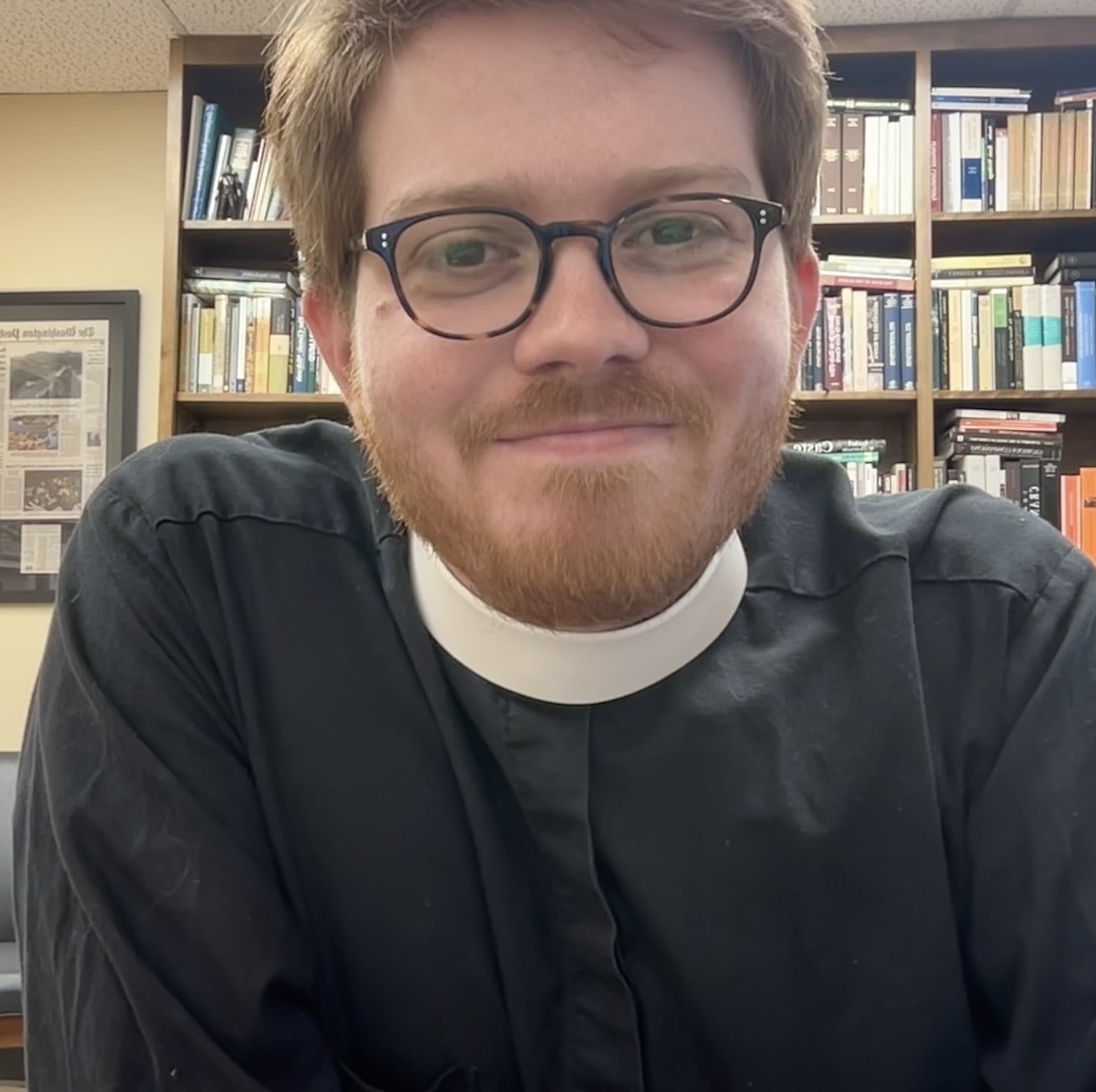
Preached on Sunday, November 22, 2026, the Last Sunday after Pentecost, at Church of the Ascension in Silver Spring, Maryland for the Welcoming of the Rev. Aaron Dunn as Rector.
“Would that all the LORD’s people were prophets, and that the LORD would put his spirit on them!” (Numbers 11:29)
Before we get to work, allow me to offer some words of gratitude. To Bishop Mariann: thank you for welcoming me into the Diocese of Washington. To the people of Ascension: thank you for welcoming me into your congregational life on such an important day. And to Aaron, our new Rector: thank you for this invitation, and more than that, thank you for the friendship we’ve shared, as well as with Jenni and Lillian. Friendship among priests is one of God’s great gifts in this strange and beautiful vocation, and your friendship has been a singular gift to me. It’s a joy to stand here with you today as this new chapter begins.
This afternoon, I want us to stay very close to that remarkable story Annie read to us from the book of Numbers. By this point, Moses has been at work for some time. God called him to lead Israel through the wilderness, and Moses has spent chapter after chapter carrying the needs, complaints, hopes, and fears of this people. And eventually, Moses reaches his limit. “I am not able to carry all this people alone,” he says to God, “for they are too heavy for me.”
That should not surprise us, and I doubt very much that it surprised Moses. The work of God is beautiful work, holy work, life-giving work––but none of it is weightless. There are people to lead and people to love, conflicts to endure and decisions to make, sorrows to carry and hopes to protect. But eventually, Moses reaches his limit, and finally, he says so.
There’s something wonderfully faithful about that moment of prayer. Moses takes his insufficiency to God and tells the truth about it. He does not disguise exhaustion as faithfulness. He does not assume that being called by God means being infinitely capable. He does not go away and devise a better system for managing an impossible burden. Moses simply says, “I am not able.” When the burden becomes too much, Moses tells God the truth. That is the first lesson in this passage for all of us: when the going gets tough, when the calling becomes heavy, when we discover that what is before us is more than we can carry, take it to the LORD in prayer.
And then comes God’s response––but notice first what God does not say! God does not say, “Come on, Moses, you can do it!” God does not tell him to try harder, to manage his time better, to get up earlier, to stay at the office later, to give up another weeknight, or to become the sort of leader who can keep every plate spinning at once. God does not reassure Moses of some hidden reserve of strength. In effect, God says, “Yeah, Moses. You’re right. You can’t do it.” I wonder how much of our lives we spend trying to convince ourselves otherwise. We devote enormous energy to becoming sufficient for things for which we were never meant to be sufficient. But here, God does not cure Moses of his insufficiency. God affirms it.
And then, God does something better. God tells Moses to gather seventy elders from among the people: “I will take some of the spirit that is on you and I will put it on them, and they shall bear the burden of the people along with you so that you will not bear it all by yourself.” God’s answer to Moses’s insufficiency is not greater self-sufficiency, but deeper relationship. God does not make Moses capable of carrying everything. God makes it unnecessary for Moses to carry everything in the first place. The burden is shared because the Spirit is shared. God’s provision for the weakness of one is the calling and gifting of others.
That alone would be enough for a sermon—but the story keeps going! Two of the elders, Eldad and Medad, have remained behind in the camp. They do not appear where the seventy are gathered. They are not standing in the proper place with the proper group. And nevertheless, the Spirit rests upon them, too. They begin to prophesy, and a young man comes running to tell Moses what has happened. Joshua hears the news and says, “My lord Moses, stop them!”
It’s such a human reaction. Something that appeared to belong to Moses is now appearing in somebody else. Something that seemed safely centered in one person has begun moving beyond him. Something that was supposed to be only for those gathered at the right time in the right place now goes to the unexpected people in the unexpected places at the unexpected time. The Spirit has escaped the neat boundaries of the arrangement, and Joshua wants to put it back. His instinct is to protect Moses by making Moses singular again.
And just that is what jealousy so often does. Jealousy is not merely wanting what another person has. At a deeper level, jealousy is a refusal of relationship. Jealousy is the desire to keep gifts scarce, to keep honor concentrated, to make sure that one person’s flourishing does not somehow diminish another’s. Joshua imagines that the greatness of Moses depends upon keeping Moses exceptional. If Eldad and Medad begin to prophesy too, perhaps Moses becomes a little less necessary, a little less impressive, a little less important.
But Moses understands what Joshua does not. The gifts of other people do not diminish his calling. Their flourishing does not threaten his place. In fact, the more widely the Spirit moves, the more fully Moses’s own ministry is fulfilled. Moses does not want the Spirit drawn back toward himself. He wants the Spirit poured out more freely. “Are you jealous for my sake?” he asks. “Would that all the LORD’s people were prophets, and that the LORD would put his spirit on them!”
Joshua wants Moses to be self-sufficient again. He wants the center to hold in one person. He wants the work, the authority, the gifts, the Spirit to be gathered back into the figure he already knows how to trust. But God has blown up that whole way of thinking. Moses is not sufficient––and that is not a failure! The answer is not to make Moses sufficient. The answer is to give the Spirit away.
Now, you might think that we have gathered to welcome a new Rector––and of course, we have. After all, just look at what we’re up to this afternoon. We have our agenda: there are prayers to pray, promises to make, and symbols to exchange. And as we welcome Aaron as Rector, when we look out on what we’re up to today, the story of Numbers may be a great inspiration, yet something a bit remote, something distant, not something that happens here and now.
But friends, let’s look again! If this service is what we say it is, then the Spirit of God is not being concentrated upon one person this afternoon. The Spirit is moving through the whole body, right this very moment. God is not simply giving Ascension a Rector. God is joining priest and people together in a ministry none of you can accomplish alone. Right now, God is placing gifts into hands all around this room––renewing callings, awakening ministries, and sharing burdens. The great action of this service is not that one person becomes responsible for the ministry of this parish—not Aaron, and not any one of you. The great action is that God gathers a people and gives them to one another. Can’t you feel it?
Now, before I finish, I want to leave you all with a few parting words.
First, to the people of Ascension: you have called a fine priest. Aaron has an unflinching integrity, a formidable capacity for work, and a wonderful sense of humor. You should prepare to laugh––a lot! You should also prepare to be challenged––a lot!––because Aaron will ask you to think carefully, to care deeply, and sometimes to go farther than you have gone before. So, love him. Pray for him. Listen to him. Let him lead you. Give him room to preach and teach, to make decisions and to take risks, to come to know you and to be known by you. Encourage him when the work is hard, tell him the truth when you disagree, and forgive him when he makes a mistake.
But do not—do not!—ask him to carry your ministry for you. After all, y’all are baptized, dang it! The Spirit of God has been at work at Ascension a century before Aaron arrived, and that same Spirit is at work among you now. God has given you gifts that Aaron does not possess, and God will call you to work that Aaron cannot do. That is not a threat to his leadership; it is what his leadership is meant to make possible. So, follow his lead, and take up your share of the work. Welcome the stranger, teach the faith, serve the poor, visit the lonely, raise up the young, give generously, forgive freely, and proclaim Christ as your Lord. Let Aaron be your priest, and together, be the Church.
And now, some final words to you, Aaron: you cannot do it. I know, I hate it, too, but it’s true: you cannot do it. Let your prayer be the prayer Moses finally mustered up: “I am not able.” And in the days and years ahead, come back to that prayer whenever you need it. Do not disguise exhaustion as faithfulness. Do not imagine that your calling requires you to become sufficient for every need placed upon your desk. You cannot carry every burden, solve every problem, attend every gathering, answer every message, preach every perfect sermon, heal every wound, or become everything these people need you to be––even though those needs are very real. You cannot do it.
So, tell God the truth about your limits. And then, look around you! Learn the gifts of these people. Trust them with real ministry. Lead them faithfully, and give them room to surprise you. When the Spirit rests upon someone you didn’t expect, remember: the gifts of your people do not diminish your ministry; they are part of its fulfillment. So, rejoice whenever you discover that God’s Spirit has been given away yet again.
Because that is finally what we all celebrate today: the gift of a God Who refuses to leave any of us alone. The burden is shared because God’s Spirit is shared––with all of us gathered here. And perhaps, years from now, when we all look back upon this new season of ministry, the great sign of God’s faithfulness will be how many others discovered that the Spirit of God had fallen upon them, too.
“Would that all the LORD’s people were prophets, and that the LORD would put his spirit on them!”


Leave a Reply